



Wallpaper for Small Rooms: How to Choose the Right Pattern, Colour and Scale
Introduction A small room asks for something different from wallpaper than a large one does. In a spacious living room, a bold print has room to breathe. In a compact...
Introduction A small room asks for something different from wallpaper than a large one does. In a spacious living room, a bold print has room to breathe. In a compact...

A small room asks for something different from wallpaper than a large one does. In a spacious living room, a bold print has room to breathe. In a compact bedroom or a narrow study, that same print is the first thing you see when you walk in, and it stays that way every day. Getting it right matters more here, not less.
If you're searching for the best wallpaper for small rooms, you've probably found plenty of pretty images of an aesthetic wallpaper for a room like yours, but little practical guidance. Colour, pattern and scale behave differently once a room shrinks, and a design that looks perfect on a swatch can feel wrong once it covers four close walls. This guide covers all three, in the order that helps most: colour, then pattern, then scale, followed by the decision most people get stuck on, a single wall or all of them.

Walls take up a bigger share of what you see in a small room, since there's less furniture, floor and window to balance them out, so colour and pattern choices carry more visual weight than they would in a bigger space.
Distance changes things too. In a large room you view wallpaper from a few metres away, where a busy print softens into texture; in a small room you're close enough that every repeat and colour transition shows, and with less natural light typically on offer, colours often look different on the wall than on the swatch. None of this means a small room should play it safe, just that colour, pattern and scale deserve a little more thought here.
Colour is usually the first decision, and it's the one with the biggest visual payoff in a small room. A few approaches consistently work well.
Soft white, ivory and warm grey push walls back visually, which is why white wallpaper designs are such a reliable place to start. They don't demand attention, so the room feels calmer and often a touch larger than it is.
Soft blues, sage greens and dusty lilacs add personality without darkening a room, and suit bedrooms or study corners where the goal is calm rather than drama.
Choosing wallpaper close in shade to your trim or ceiling avoids the harsh line where wall meets ceiling, often what makes a small room feel boxed in.
Dark or saturated wallpaper isn't off limits. It works best on a single wall, or where natural light is strong for part of the day; across every wall in low light, the same colour can feel heavy rather than cosy.
Colour is also one of the easier things to adjust once wallpaper is made for your own space. We're often asked whether a design can be shifted a shade lighter or darker, and with most of our designs, that's possible.

Once you've settled on a colour direction, pattern is next. The right print can make a small room feel considered rather than cramped.
A print with small, evenly spaced motifs tends to read as calm rather than busy, even up close. Tightly packed, oversized prints can feel overwhelming when you're rarely more than a metre or two from the wall.
Anything with a vertical emphasis, a subtle stripe or a pattern with a tall repeat, can visually lift a low ceiling, one of the simplest tricks for a room that's short on height.
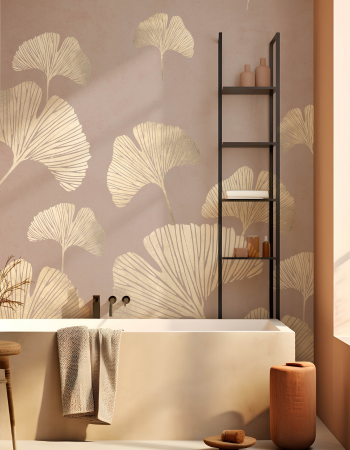
Patterns with visible space between motifs avoid the cluttered look dense prints create in a tight space, so a tropical leaf print or an abstract design with generous spacing tends to work better than one where the background barely shows.
Tonal florals or subtle geometrics, where pattern and background sit close in shade, add interest without competing for attention, a good middle ground if you like pattern but don't want it to dominate.
Pattern doesn't have to be one size fits all. A print suited to a large wall isn't automatically wrong for a small one, but it usually needs a different scale, covered next.

Scale is where a lot of small rooms go wrong. A print that looks charming on a screen or a swatch can behave very differently once it covers an entire wall.
Oversized motifs are the most common issue, since a large-scale print can get cropped awkwardly at the edges of a small wall, making the room feel more cramped rather than dramatic. Very small, busy micro-patterns viewed up close, the normal distance in a small room, can feel noisy instead of subtle.
A single, mid-to-large motif used almost like a hero print often works better on one wall than a busy, repeating pattern across all four. It gives the eye something to focus on rather than something to process.
The safest way to judge scale is against your actual wall dimensions, not the swatch in your hand or the picture on a screen. It's one of the reasons we make wallpaper to a customer's own measurements rather than fixed size so that the scale of a print can be adjusted so that something that would otherwise feel too big or too small for your wall is resized to fit it properly before it's printed.
Once colour, pattern and scale are settled, there's one more decision that shapes whether you've actually landed on the best wallpaper for small rooms: a single wall, or all of them?
|
Feature wall |
All walls |
|
Lower commitment; the rest of the room stays neutral. |
An immersive, cohesive look throughout the room. |
|
Works well behind a clear focal point, like a bed or desk. |
Best suited to lighter, smaller-scale or tonal patterns. |
|
Easier to update later without redoing the whole room. |
Can make a small room feel bigger, when judged well. |
|
Suits a shared room where the pattern shouldn't dominate. |
Suits rooms meant to feel enveloping, like a nursery. |
Neither approach is right by default. A feature wall suits a clear focal point and a lower appetite for risk. Papering every wall suits a room where the pattern should feel like part of the architecture, not an accent.

If you're still looking for a direction rather than a rule, here are a few of the design categories we work in that tend to make for an aesthetic wallpaper for a room this size.
These are starting points, not a full catalogue. Our design range covers more ground too, from spiritual artwork to contemporary geometrics, worth a browse if none of these quite fit.
Small rooms rarely come in standard sizes, which is exactly why we build every order around the room it's going into rather than a fixed template.
We ask for your wall's actual dimensions, including any doors, windows or alcoves that affect the space, and the wallpaper is produced to fit that wall specifically. This matters more in a small room, where a few centimetres of miscalculation is far more noticeable than on a large wall.
Depending on the design, colour, scale, texture and finish can usually be adjusted. If you'd rather apply it yourself, our self-adhesive textured option, a peel-and-stick material, suits smaller rooms or rented spaces where a simpler application matters.
Once your order is confirmed, we share a digital proof so you can see how the design looks at your wall's real size before production starts, a useful check when scale is hard to judge from a swatch alone.
Getting in touch is simple. Most customers start the process through our website or over WhatsApp, and we're always happy to talk through material options if you're not sure which one suits your space.
The right wallpaper for a room's walls often depends less on the size of the room and more on the style you're already working with. Here's how a few common interior styles translate to a small space.
Stick to tonal, low-contrast patterns, white wallpaper designs or muted abstracts, adding texture without a second focal point competing with your furniture.
Pichwai or other Indian heritage motifs work beautifully here, usually as a single feature wall so the detail gets the attention it deserves.
Here you can be more generous with colour. Tropical or botanical prints used freely suit a room meant to feel layered and personal.
Softer, smaller-scale kids' designs suit a compact room without overwhelming it, especially useful in a nursery or a shared children's room.
The same principles from earlier still apply, whatever your style. A traditional bedroom benefits from the same scale and colour thinking as a minimalist one; only the print changes.
A few mistakes come up again and again when people shop for the best wallpaper for small rooms, and most of them are avoidable once you know to look for them.
Most of these come down to the same thing which is treating a small room like a scaled-down version of a big one, instead of a space with its own rules.
A small room doesn't need fewer design decisions. It just needs the right ones. Get the colour, pattern and scale right, and even a modest bedroom or a narrow study can feel like one of the most considered rooms in the house.
If you're at the point of picking an actual design, wallpaper made to your room's own measurements takes a lot of the guesswork out of everything covered above. You can explore our wallpaper designs to see what's available, or if it's a bedroom you're working on specifically, our bedroom wallpaper collection is a good place to start. Either way, we're always happy to help you figure out what will actually work for your space, not just what looks good in a photo.

Your cart is currently empty.
Start Shopping


