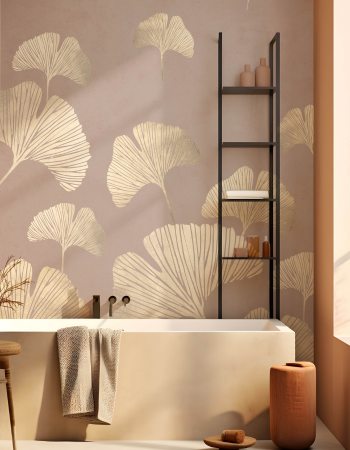
Custom wallpaper is printed for one wall: yours. That's the appeal, and it's also why quality deserves a careful look early. Once the measurements are fixed and the design goes to print, there's little room to change course, and a phone screen only tells part of the story.
Knowing how to check wallpaper quality before buying comes down to one idea. A finished wall is only as good as the weakest step behind it: the artwork, the print, the base material, the sizing, the wall and the installation. This guide defines premium quality, walks through nine checks and shows how to evaluate an order, so the wallpaper for walls you choose looks as good in the room as it did on screen.
What Does Premium Quality Mean for Custom Wallpaper?
With customised wallpaper for walls, premium quality describes how well a design holds up between the artwork file and the finished wall. It should look as sharp, balanced and well fitted on the wall as it did in the design. Four layers decide that:
Artwork. The design is composed for wall scale, with detail that holds up when enlarged.
Reproduction. Colour, sharpness and consistency carry through the printing process.
Substrate. The base material and its finish suit both the design and the room.
Fit. The wallpaper is sized, scaled and installed for that specific wall.
Every custom order is a one-off, so there's no finished roll in a shop to inspect. Quality is judged from close-ups, samples and the proof. A higher price or the word "luxury" on a listing tells you little on its own, and even a well-made design will look tired on a damp or uneven wall.
The 9-Point Custom Wallpaper Quality Checklist
The nine checks below follow the order a design travels in, from artwork to installation, and they work on any wallpaper you're considering.
1. Artwork Quality and Detail at Wall Size
Start with the artwork, because printing can reproduce detail but can't add it. A design created for wall scale holds up when enlarged. A small image stretched across a wall doesn't, and the difference shows within arm's reach.
Zoom in on the close-ups. Linework should be crisp, with brushwork or texture visible where the style calls for it. Blur, jagged edges, blocky patches and smudges are warning signs, and so are elements that look copied to fill extra width.
Indian wallpaper designs in heritage styles such as Pichwai, Gond or Chinoiserie-inspired work deserve a closer look, since the motifs should follow the style's own conventions of line, colour and composition rather than looking like a filter over a photograph. Using your own photo or artwork? Ask whether the file is large enough and whether it will be checked before printing.
2. Print Sharpness and Colour Reproduction
The printing method and inks affect colour depth, how fine detail holds and whether any smell lingers after installation, so ask about both, and treat any eco claims as the seller's own description.
Some difference between screen and print is normal, because a screen is backlit and printed colour depends on the ink, the base material and the light in your room. Pastels, deep blues, skin tones and gold-like yellows show the shift most. Check gradients and dark areas too: skies shouldn't show stripes (known as banding), and dark grounds should keep their detail instead of turning muddy. Where possible, hold a printed sample against the wall in daylight and in the evening.
Printed gold is a colour rather than a metallic finish, so if you want real shine, confirm whether a specialised finish is included.
3. The Base Material and Its Finish
The base material, or substrate, affects how the print sits, how it's cleaned, whether it's glued or peel-and-stick, and which rooms it suits. It changes the artwork too. Canvas and fabric-like textures soften fine lines and give a painted feel that suits loose, painterly designs, while smoother bases keep detailed botanicals and line art crisp.
Then match the material to the room. Bathrooms and kitchens bring moisture, kids' rooms and passages get touched often, and some walls take strong afternoon sun. Water resistant is not the same as waterproof, and cleaning methods vary by material, so ask for the care instructions for the exact one you're ordering and feel a physical sample if you can.
4. Customisation Options That Suit the Design
Most custom wallpaper lets you adjust colour, scale, size, material, texture or finish, though not every design allows every change. Treat recolouring as a design decision. Changing a single colour can unbalance the whole palette, and heritage styles often depend on particular colour combinations to look right. Whatever you change, ask to see it on the proof before production begins.
5. Scale and Fit for Your Exact Wall
On a custom order, scale is a choice. The same artwork looks different on a 2.5-metre wall than on a 4-metre one, so check how large the key motifs will appear and which part of the artwork will show.
Measure width and height at more than one point, since few walls are perfectly square, and note every door, window, switchboard and AC unit. Then picture the room furnished: a headboard, sofa or TV unit can cover the very part of the design you chose it for.
Custom 3D wallpaper needs extra care. These designs use printed perspective, shadows and horizon height to suggest depth, and stretching or over-enlarging them breaks the effect. The horizon works best near the room's natural eye level, lower in a seating area than in a hallway. Before approving anything, tape out the main elements on the wall at real size.
6. A Digital Proof You Can Actually Check
The proof is your last easy chance to fix a problem, so treat it as a sign-off. Once made-to-measure wallpaper goes into production, changes are rarely possible. When it arrives, confirm that:
- the dimensions match your measurements
-
the part of the artwork you expected is visible
- focal elements sit where you want them in relation to furniture, doors and windows
- every change you asked for has been made
Zoom to 100% on the detailed areas. A proof on screen is dependable for layout and scale but less so for exact colour, where a physical sample helps.
7. Panel Joins and Pattern Continuity
Made-to-measure wallpaper arrives in panels, and the joins are where quality shows up close. Find out how wide the panels are, how many your wall needs and where the joins will fall, since a seam through a face, a deity or a central bird is hard to miss. Confirm how the panels join and match, and that they're numbered or sequenced. Colour should run evenly from one panel to the next, which is easiest when the full quantity is printed together.
8. Wall Readiness Before Installation
Wallpaper follows the surface beneath it. It won't hide cracks, damp or uneven plaster, and many finish problems, such as bubbles, lifting edges and visible bumps, begin with the wall.
Before installation day, the wall should be smooth, clean, dry and sound. Fill cracks, scrape off flaking paint, sand down bumps and clear the dust. Damp needs fixing at its source first, so check external walls and any wall shared with a bathroom or kitchen, particularly after the monsoon. New plaster, putty or paint has to dry fully before papering, and your installer can advise on primer and timing. Peel-and-stick materials need an especially smooth, dust-free surface to hold well.
9. Installation Method and Installer Experience
Confirm how your chosen material is installed, with glue or as peel-and-stick, and which adhesive is recommended. Clarify who is installing it and who is responsible for the finish, since many sellers treat installation and wall issues separately from product defects.
Experience matters more than people expect. Hanging made-to-measure murals and panels means aligning the first panel accurately, keeping the sequence and trimming without cutting into the artwork, which is different from hanging plain wallpaper. Ask whether your installer has done it before. Before they leave, check the joins, the edges at the ceiling and skirting, and the cut-outs around switches.
 How to Evaluate a Custom Wallpaper Order From Design to Installation
The checklist covers what to look for. This section covers when, since most problems are simplest to fix before printing and before pasting.
|
Stage
|
What to check
|
Your action
|
|
Shortlisting
|
Close-ups, artwork detail, style accuracy
|
Ask about the print method and inks
|
|
Before you order
|
Measurements, material, room conditions
|
Request a sample and agree on customisation
|
|
Digital proof
|
Size, visible artwork, focal points, requested changes
|
Approve only when everything matches
|
|
Delivery
|
Panel count, sizes, pattern, colour, transit damage
|
Compare with the proof and photograph any issue
|
|
Installation and after
|
Wall preparation, joins, edges, cut-outs
|
Check before the installer leaves; follow care instructions
|
Give delivery day extra attention and check everything against the proof before pasting. Once a panel is up, it's much harder to tell whether a problem came from the print, the wall or the installation.
How Space of Joy Fits Into Your Custom Wallpaper Quality Checklist
At Space of Joy, every wallpaper we make is printed to your wall's measurements, so these are questions we're glad to answer. Our range spans Pichwai, Gond and other Indian heritage styles, along with Chinoiserie, florals, tropicals, modern abstracts, kids' designs and spiritual artwork, giving you a wide choice of wallpaper designs in India. This is how we handle each check:
|
Check
|
How we handle it
|
|
Print
|
We use hybrid UV printing with water-based inks, which our FAQ describes as zero-VOC.
|
|
Material
|
Non-Woven Plain and Non-Woven Textured: dry dusting only, no soap or chemicals. Self-Adhesive Textured and Water Resistant: wipe with a mild shampoo cloth. We suggest Water Resistant for bathrooms, kitchens and kids' rooms.
|
|
Customisation
|
Colour, scale, size, material, texture or finish, depending on the design, discussed with us on WhatsApp.
|
|
Fit
|
Made to your wall measurements, including door and window sizes.
|
|
Proof
|
We share a digital proof in your size on WhatsApp, after order confirmation and before production.
|
|
Panels
|
36 to 52 inches wide, laid out on the floor before pasting so the design lines up.
|
|
Quality check
|
We check each order for size, design and defects, then pack it in tubes and wrap it for transit.
|
|
Installation
|
Glue-based for standard materials, peel-and-stick for Self-Adhesive Textured. Install it yourself, use a local installer, or ask us to connect you with one in major cities (paid on site).
|
Two things sit outside our control: the wall and the installation. Issues caused by either aren't treated as product defects, so the wall checks above still matter. Planning a bedroom? Browse our customized wallpaper for bedroom designs and ask us what can be adjusted.
Plan Your Custom Wallpaper With Space of Joy
The most useful thing to remember about how to check wallpaper quality before buying is timing. Look closely at the artwork, print, material and wall before you approve the proof, and most quality problems are solved before they can start.
When you're ready, shortlist a design, measure your wall along with its doors and windows, and send us your customisation requests on WhatsApp. We'll share a proof in your size, and you can review it against this checklist before anything is printed.