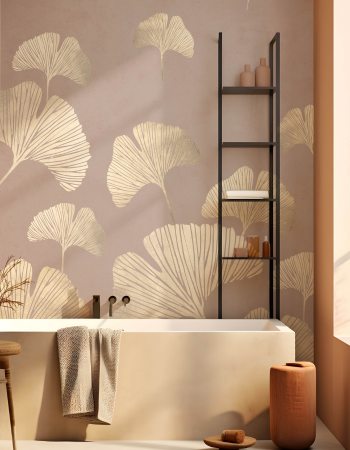
You've shortlisted a design and measured the wall. Now comes the harder question: should that wall carry one large artwork, or a pattern that repeats from corner to corner? The choice between mural wallpaper vs repeat pattern wallpaper comes down to structure. A mural is a single composition, a repeat is a motif set on a rhythm, and each behaves differently once furniture, windows and viewing distances come into play.
This guide covers scale, composition, wall types, furniture and customisation, so you can choose wallpaper for walls that suits the room it's going into.
Mural Wallpaper vs Repeat Pattern Wallpaper: What's the Difference?
A mural is one continuous image planned for a specific wall, much like a painting at full scale. A repeat pattern uses a motif that repeats at fixed intervals across and down the wall, so it can run as far as the wall does.
|
Factor
|
Mural wallpaper
|
Repeat pattern wallpaper
|
|
Structure
|
One complete scene
|
A motif repeated at set intervals
|
|
Sizing
|
Planned around one wall
|
Extends to any width or height
|
|
Focal point
|
A clear centre of interest
|
None; the rhythm leads
|
|
Coverage
|
Usually one feature wall
|
One wall or a full room
|
|
Common themes
|
Scenery, landscapes, large botanicals
|
Florals, geometrics, small leaf motifs
|
|
Role in the room
|
The artwork
|
The backdrop
|
Theme alone won't settle it. Nature themed wallpaper comes in both formats, and a sweeping jungle scene and a small leaf wallpaper for walls in a hallway behave differently once they're up.

How Scale Changes the Look of Mural and Repeat Pattern Wallpaper
Scale is the size of a design in relation to the wall and the room. A design that looks right on a phone screen can read differently at full size.
Mural scale is tied to the wall. A mural is sized to the wall's width and height, so the same scene looks different on a 2.5-metre wall than on a 5-metre one.
Repeat scale has two parts: the size of the motif and the distance before it repeats. Small motifs read as texture from across a room, and large ones read as pattern. On a small wall, a large repeat may show only a motif or two, which can look cut off.
Viewing distance matters. Up close in a compact bedroom, you'll notice fine detail. From the doorway of a large living room or lobby, a delicate repeat blurs into one tone, while a mural's main shapes still read clearly.
Room size isn't a strict rule. A scenery wallpaper for walls with an open sky or distant horizon can make a compact wall feel deeper, while a busy small repeat can crowd the same room. Tall trees and vertical stems draw the eye up, which helps a low ceiling.
Before you commit, tape out the key elements on the wall at real size.
Composition vs Repetition: How Each Wallpaper Format Behaves on a Wall
Once installed, the two formats respond differently to what's around them.
|
On the wall
|
Mural wallpaper
|
Repeat pattern wallpaper
|
|
Where the eye goes
|
Straight to the focal point
|
Across the whole surface
|
|
Wall partly covered
|
Can hide a key element
|
Pattern still reads
|
|
Doors, windows, switches
|
Cut into the composition
|
Absorbed with little loss
|
|
Panel joins
|
Panels follow the image in order
|
Motif must line up at every join
|
|
Turning a corner
|
Image splits
|
Pattern continues
|
Mural Wallpaper: Designed as One Composition
A mural has hierarchy: a main subject, supporting elements and quieter areas. The focal point should sit where people naturally look, centred above a bed or sofa, or placed off-centre on purpose to balance the layout. That also makes a mural less forgiving. A window through the main subject or a headboard over the horizon breaks the picture. With scenic designs, check the horizon height against your eye level, seated and standing, and keep to one mural per sightline so two scenes don't compete.
Repeat Pattern Wallpaper: Built on Rhythm
Repeats have no focal point of their own, which leaves your furniture, art or lighting free to lead. You can cut around a window or hide part of the wall and the pattern still holds. It does need careful matching at the joins. In a straight match, the motif lines up across each panel; in a half-drop, it shifts down by half a repeat on alternate panels for a diagonal flow. Spacing matters too, since dense patterns can tire the eye on a large wall.
Mural vs Repeat Pattern Wallpaper for Different Wall Types
The shape of your wall, and what interrupts it, often settles the choice faster than style does.
|
Wall type
|
Mural
|
Repeat pattern
|
Usually better
|
|
Feature walls and niches
|
Strong on open walls, weaker in niches
|
A calm backdrop or small accent
|
Mural, or depends on the design
|
|
Large walls and staircases
|
Holds its impact at a distance
|
Large motifs read well
|
Either
|
|
Walls with doors, windows or AC units
|
Openings cut the image
|
Absorbs cut-outs
|
Repeat
|
|
Connected walls or a full room
|
Splits at corners
|
Wraps around
|
Repeat
|
Feature Walls, Niches and Smaller Walls
A bed or sofa wall is the natural home for a mural, since it offers one clear view. In a niche or alcove, a large scene can lose its story, so pick a mural with one simple subject or a repeat that shows at least two full motifs.
Large Walls, Corridors and Staircases
Double-height walls suit murals, while small repeats can turn monotonous across a big surface. Corridors and staircases are seen on the move, so a scene that unfolds along the length works, as does a repeat that keeps a long run consistent.
Walls With Doors, Windows, Switches or AC Units
Openings cut straight through a mural but barely affect a repeat. If you still want a mural here, measure every opening first, because its position decides whether the focal area stays clear.
Several Connected Walls or a Full Room
Repeats wrap around corners and carry on. A mural folded across a corner splits its image, so a mural on one wall with a coordinating repeat on the rest is a practical middle path.
Both formats need a smooth, clean, dry wall. Neither will hide cracks, damp or loose paint, so fix those first.
How Furniture Placement Should Influence Your Wallpaper Choice
Map what will cover the wall. Headboards, sofa backs, consoles, TV units and shelves all hide part of it. The visible area is what your design has to work with.
Keep a mural's focus above the furniture line, and check it from where you'll sit as well as stand.
Let repeats handle busy layouts. A repeat partly hidden behind furniture still reads as a whole.
Match the symmetry. A centred bed or sofa pairs well with a centred mural, while off-centre layouts suit an asymmetric scene or a repeat.
Plan around wall-mounted pieces. Keep a TV or mirror off a mural's focal point. On a dense repeat, framed art can get lost, so choose a quieter pattern.
Consider future changes. A mural is planned around today's layout. If you like to rearrange, a repeat adapts more easily.
Mural or Repeat Pattern: Which Format Works Best for Different Rooms?
Living and Dining Areas
These rooms have the longest viewing distances, so a mural on the wall you face from the sofa or table works as the main artwork. In open-plan spaces, a repeat keeps connected walls flowing. Keep murals off the TV wall.
Bedrooms
The bed wall is often seen lying down and in soft evening light, so calmer designs work best, such as a quiet scenic mural or a gentle leaf repeat. Our bedroom wallpaper collection includes several landscape and forest scenes.
Kids' Rooms and Nurseries
A storytelling mural at a child's eye level can become the room's favourite wall. A repeat is easier to live with as the child grows older.
Workspaces and Commercial Spaces
Behind a video-call desk, a repeat is less distracting. In receptions, cafés and lobbies, a mural makes a strong signature wall, and repeats keep corridors consistent.
Powder Rooms
An all-over repeat wraps a small powder room neatly, or one mural wall becomes a pleasant surprise. For moisture-prone rooms, we offer a Water Resistant material coated on both sides. Note that it's water resistant, not waterproof.
You also don't have to pick only one. A mural on the feature wall with a coordinating repeat nearby, in a shared palette, gives a room a focal point and continuity.
Custom Mural Wallpaper vs Custom Repeat Pattern Wallpaper
|
Factor
|
Custom mural
|
Custom repeat pattern
|
|
Main adjustment
|
Fitting the scene to your wall
|
Motif scale and colourway
|
|
Key decision
|
Focal point against furniture and openings
|
How it meets ceiling, skirting and corners
|
|
Check on the proof
|
Focal point, horizon, cut-outs
|
Motif size at full scale
|
Custom Mural Wallpaper
Here the aim is to fit the composition to your exact wall. Decide where the focal point should fall in relation to furniture, doors and windows, and consider adjusting colours to suit the room. On the proof, check the focal point first, then the horizon, then where openings cut into the image.
Custom Repeat Pattern Wallpaper
For a repeat, scale is the main lever. Choose a motif size that suits your wall and viewing distance, then settle the colours. On the proof, check how large the motif looks at full size and how the pattern meets the ceiling and corners.
How Space of Joy Can Help You Plan Wallpaper Around Your Space
Every wallpaper we make is produced to your measurements, so the planning happens before anything is printed. Our designs include scenic landscapes, tropical botanicals, florals, Chinoiserie and Indian heritage art. This is how an order comes together:
-
Measure your wall. Note its width and height, along with the size of every door and window, and double-check the figures, since we make your wallpaper to them.
-
Choose your design and material. Pick from Non-Woven Plain, Non-Woven Textured, Self-Adhesive Textured (peel-and-stick) or Water Resistant. The non-woven options need dry dusting only; the other two can be wiped with a mild shampoo cloth.
-
Ask us about customisation. Message us on WhatsApp to adjust colour, scale, size, material, texture or finish, depending on the design.
-
Place your order and review the proof. Once your order is confirmed, we share a digital proof in your size on WhatsApp, so you can check the focal point, furniture line and openings.
-
Production and dispatch. We print to your measurements, check the wallpaper for size, design and defects, and pack it in tubes.
-
Installation. Our panels, 36 to 52 inches wide, are laid out in order on the floor before pasting. You can install them yourself or ask us to connect you with an installer in major cities.
Choose a Wallpaper Design That Fits Your Wall With Space of Joy
A mural works best on a clear wall with one intended view. A repeat pattern is the steadier choice for walls broken by doors and windows, for connected walls, and for rooms where furniture moves around. When weighing mural wallpaper vs repeat pattern wallpaper, start with the wall, then the furniture and viewing distance, and choose the design last.
When you're ready, browse our collections or send us your wall measurements and a photo on WhatsApp. We'll help you choose the right format.